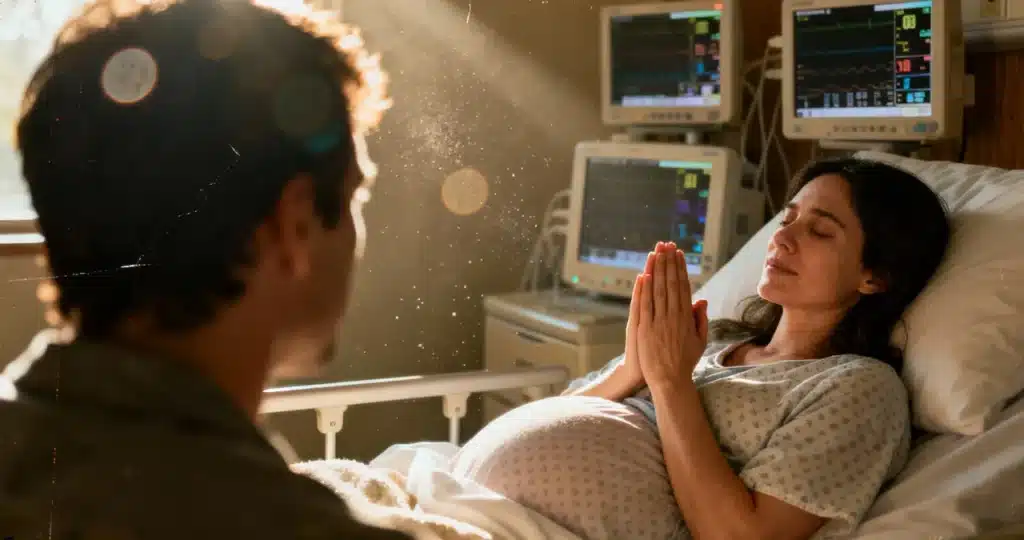
The morning of Jessica’s miracle birth story began at her 19-week pregnancy checkup, a day that started like any other, filled with the quiet anticipation of growing life. She and her husband, excited parents to a two-year-old daughter, were navigating family joys with newfound faith as new believers. But everything changed after a simple nap when Jessica woke to an unexpected gush of fluid, at first dismissed as a minor pregnancy mishap.
As hours turned into an anxious wait in the hospital, more leaks followed, shifting embarrassment into fear. What no one yet realized was that her waters had broken far too early, launching her into a high-risk pregnancy where she would spend months fighting to keep her baby alive, and ultimately defied odds that doctors said made survival nearly impossible, culminating in the miracle birth that redefined their lives.
In the ultrasound room, the technician’s words hung heavy: confirmation of a complete rupture of membranes, leaving no amniotic fluid to protect or nourish the baby. Jessica’s world tilted, but her resolve sparked amid the fear.
The High-Risk Pregnancy Crisis
Transferred to Burnaby Hospital, Jessica faced a stark reality.
Doctors explained the preterm premature rupture of membranes (PPROM), a condition where the amniotic sac breaks early, exposing both mother and baby to severe risks. “You’ve lost a lot of your amniotic fluid,” one doctor said, wiping tears from her eyes. She outlined grim scenarios: natural labor within 24 hours leading to miscarriage, fatal infection within 48 hours, or termination.
At just 19 weeks, the baby wasn’t viable outside the womb, no machines could save him, there would be no miracle birth.
The prognosis was devastating. Without amniotic fluid, the baby’s lungs couldn’t develop properly, as it was essential for branching like a tree. Infections loomed for both, and Jessica’s body began contractions, signaling impending loss.
“You’re basically a ticking time bomb,” a specialist later warned.
Research over the weekend revealed a mere 15% survival chance, dropping to 3% for a healthy outcome even if carried longer. Down syndrome was mentioned as a potential complication, adding layers of heartbreak.
Jessica’s husband arrived, eyes red from tears, as their life group rallied in prayer. Yet the medical team pushed for decisions, emphasizing the impossibility. “We do have a team standing by that can perform a termination right now,” they offered, underscoring the hopelessness.
Divine Intervention in Desperate Moments
As despair set in, divine timing began to weave through the chaos. Jessica’s husband, rushing from work, passed his assistant, a strong believer, who overheard and immediately prayed.
Scriptures flooded her: “Before I formed you in your mother’s womb, I knew you.” Unbeknownst to the couple, this sparked a chain of intercession.
At BC Women’s Hospital, specialists couldn’t intervene surgically or add fluid. Doctors can’t reproduce amniotic fluid. Yet, against expectations, contractions stopped overnight. “The baby hasn’t come yet,” Jessica told her husband, surprised. Transferred for advanced monitoring, she clung to hope, researching how membranes could reseal like a healing cut. The baby’s own urine recycling into fluid offered a glimmer, but risks mounted: potential cord prolapse, where the umbilical cord hung in fluid, threatening oxygen supply.
Miraculously, no infection developed over days. Bed rest became her shield, with antibiotics and monitors as allies. God’s fingerprints appeared in small ways, like the peace Jessica felt amid fear, hinting at supernatural protection.
Faith and Prayer Mobilize an Army
Jessica’s faith ignited fiercely.
As new believers, they rejected termination outright. “We just say that it didn’t even cross our mind,” she recalled. Instead, they turned to prayer. Their life group fasted, gathered, and declared scriptures. “I’m praying until the very last,” Jessica vowed, apologizing to her baby in tearful nights but trusting God’s plan for a miracle birth.
Community support exploded. Friends cared for their daughter, allowing focus on the fight.
At a healing service, peace enveloped Jessica: “Peace filled my mind. Peace filled my entire being. I knew that no harm could come near me.” Psalm 91 became her anchor: “No disaster will come near your tent.” Global prayers poured in as word spread, with prophetic words affirming the baby’s purpose.
Specific acts amplified their faith.
Jessica read pregnancy books obsessively, advocating against misdiagnoses. “They messed up many times,” she noted of medical oversights.
Yet, she declared life over her womb, blending medical compliance with spiritual warfare.
The Turning Point: Signs of Life Amid Doubt
For two agonizing months, Jessica battled on bed rest, staring death down.
Infections threatened, but none came. At 27 weeks, labor intensified with a suspected cord issue, the umbilical cord “hanging in this fluid.” Emergency C-section loomed, but the main doctor, prayed for specifically, arrived unexpectedly.
Delivery revealed a full placental abruption; the baby, Caleb, was born without a pulse, dead by medical terms, with an Apgar score of zero.
Yet, 30 seconds later, his heart restarted. “Your son was born dead… but his heart started beating on its own,” the doctor explained, having given a transfusion boldly.
Doctors saw it as luck; Jessica called it resurrection.
Caleb entered the NICU as the sickest baby, paralyzed initially to aid machines. One nurse monitored him constantly, a rarity even in this top facility serving western Canada. Jessica felt guilt: “my body failed him”, but shifted to prayer. Daily, she asked the head doctor, “What are your concerns today?”
Issues arose: heart malfunction, brain oxygen deprivation.
Yet, miracles unfolded. Life group prayed targeted prayers; the next day, concerns vanished. “No hearts. We can find them,” the doctor admitted. Brain scans cleared inexplicably. Scriptures on a bedside board declared: “The child grew and became strong… the grace of God was upon him.”
Caleb breathed independently soon after, needing only to grow.
The greater miracle transformed their family. Jessica’s resilience deepened their faith; Caleb, now 15, thrives without medical traces, no surgeries, no indications of trauma. He’s a downhill ski racer, mountain biker, full of energy.
“There is no medical indication that he went through this,” Jessica shares. Their marriage strengthened, rooted in God’s faithfulness.
Doctors Confront the Inexplicable in This Miracle Birth
Medical staff marveled. The head doctor patted Jessica’s shoulder: “I have no concerns. Your baby just has to grow.”
Specialists who’d predicted disability admitted, “I’ve never seen anything like this.” Skeptics witnessed what faith wrought, shifting from termination pushes to awe.
Jessica hopes her story inspires. “God is faithful… his word is powerful,” she says. For families in crisis, it’s a beacon: defy odds through prayer. Professionals might pause next time, recalling this miracle birth.
“Whatever you’re battling, it is an evil lie… speak to that mountain and it will move.”
The testimony urges bold faith. In high-risk pregnancy storms, collective prayer and trust yield breakthroughs. Jessica’s journey proves no prognosis final, God writes the end.
Watch the Miracle Unfold
The full depth of Jessica’s defiance against death, her unyielding prayers, medical battles, and Caleb’s triumphant life is best witnessed in her own words. On Jan The Miracle Hunter’s YouTube channel, she recounts:
- The terrifying rupture at 19 weeks and the doctor’s tearful prognosis: “You have three situations right now that could happen.”
- The peace from a healing service: “I knew no disaster could come near my tent.”
- Caleb’s stillbirth and revival: “Your son was born dead… but his heart started beating on its own.”
- Daily miracles in NICU: “What are your concerns today?” leading to cleared heart and brain issues.
Praise God! We give Him all honor and glory for this miracle!